Q. Per paragraph 7.92 in CMOS, some compound adjectives keep a hyphen even after a noun, including compounds with “ill” (also covered under “ill” in the hyphenation table). For example, we could be correct in writing this: “The scene was ill-described.” In cases where the compound is not in play, I assume we stick to dropping the hyphen, since we’re now working with just an adverb + verb. For example: “Gruesome ill described the scene.” Is this correct? I suspect I’m overthinking things. (Revising the sentence beyond mechanical correctness is out of the question in this client’s case.)
A. Though CMOS doesn’t cover this specific case, common sense does suggest that you wouldn’t need a hyphen when an adverb is paired with a past participle used as a verb rather than as an adjective. You could try substituting a different adverb for ill to test this hunch: “Gruesome now described the scene.” A hyphen would be out of place there.
But the wording in your sentence is unusual—ill is rarely paired with verbs other than afford, treat, or use—so hyphenation might be helpful. The expression ill afford is in Merriam-Webster without a hyphen, but that phrase generally has only one form: can (or could) ill afford. By contrast, both ill-treat and ill-use are entered as hyphenated verbs, giving you a couple of models to follow.
Verdict? A hyphen in your example, though not strictly required (see also CMOS 7.96, sec. 2, under “phrases, verbal”), may help clarify that ill belongs with the verb. You could add one (“Gruesome ill-described the scene”) unless your client prefers otherwise.
Q. In Spanish text, titles of books are set in sentence case, but should they also be set in italics? And how about titles of book series and the like?
A. If you’re applying Chicago style, and often even if you’re not, book titles are italicized in Spanish-language contexts, whereas series titles are usually in roman (regular) type—both as they would be in English.
So, whether your text is in Spanish or English, you would refer to The Chicago Manual of Style (note the title case, usually retained for English titles in Spanish-language contexts) but el (or “the” in English contexts) Manual de estilo Chicago-Deusto (a version of CMOS adapted for Spanish and published in 2013 by the University of Deusto, or Universidad de Deusto, in partnership with the University of Chicago Press; as with books in English, an initial article isn’t always part of the title).
As for a book series, you would refer to (for example) Bonsái (Editorial Anagrama, 2006), a novel by Alejandro Zambra published as part of the series Narrativas hispánicas. Again, these novel and series titles would be treated the same whether your text is in English or Spanish. Titles of series, though, occasionally appear in title case, which is how names of periodicals and publishers are usually treated (e.g., the journal Revista Mexicana de Sociología or the publisher Fondo de Cultura Económica). When in doubt, follow the usage in the source.
For more guidance, consult Chicago-Deusto. Additional resources are available online from the Real Academia Española, including the freely accessible Libro de estilo de la lengua española (a Spanish stylebook first published in 2018); in that guide, see “Clase de letra” (on styling text), and especially “Cursiva demarcativa para delimitar expresiones denominativas” (on italics for titles of books and the like).
In CMOS, see paragraphs 11.67–76. For the titles of book series, which are sometimes in italics, see 8.178.
Q. What is the rule on hyphenating multiple colors? For example, it would be “a black-and-white photo,” but you never see any other color combinations hyphenated (like “a pink-and-yellow scarf”).
A. Putting something in black and white has been a thing for centuries; according to Merriam-Webster, the noun phrase black and white to mean writing or print dates to 1569. Once color photography became popular, the adjective black-and-white—with hyphens—was probably inevitable.
A pink-and-yellow scarf, on the other hand, or one that’s red and white or blue and green or any other combination you can think of? Those are arbitrary combinations. But you should hyphenate any one of them as a preceding modifier regardless (as at the start of this paragraph), at least if you’re following Chicago style. Hyphens will make it more obvious that you aren’t referring, for example, to a pink and a yellow scarf.
This issue is not, however, black and white. For more on this subject (including why we’ve left the hyphens out of black and white in the first sentence of this paragraph), see “Compound Modifiers After a Noun: A Postpositive Dilemma,” at CMOS Shop Talk.
Q. I’m reviewing an academic research paper in which the authors describe their process and their findings in the present tense. “We evaluate . . . We analyze . . . We review.” Obviously, these actions have already taken place, so I lean toward changing the sentences to past tense. But perhaps it’s acceptable to use the present tense in academic research, similar to the use of historical present tense in literature. Please help!
A. The historical present can be a reasonable choice for things that can be consulted by others, starting with the paper itself. For example, “In this report, we evaluate three different theories of . . .” Other sources can likewise be referred to in this way: “Smith (2021) argues that . . .”
But for actions as opposed to text, a form of past tense is usually best: “We reviewed the flight logs at five major international airports . . .” The past tense is also usually best when referring to something as predating something else: “In a previous paper, Smith (2020) argued for . . .” Or, “In previous papers, Smith (2018, 2020) has argued for . . .”
If in doubt, default to a form of the past tense, which would work well in any of the examples in this answer except for the first (though you could switch to past if, for example, you were to change “In” to “For”: “For this report, we evaluated . . .”). But if the paper is going to be published in a journal or with a specific publisher, ask that journal or publisher about any preferences related to verb tenses; also look at recently published articles in your field.
Q. I am writing a poem with the phrase “marine helicopters”: “In the silvery drizzle, / a pair of Marine helicopters / flying low on maneuvers . . .” These are indeed helicopters of the United States Marine Corps. Would “marine” or “Marine” be correct in this circumstance?
A. In documents published by or for the US Marines, it’s “Marine,” with a capital M, whether the term is singular or plural and regardless of the part of speech. But outside the Marine Corps (and unless the focus of the text is the US military), the word “marine,” like “navy” or “naval,” can usually be lowercased when used by itself as a noun (“a marine,” “the marines”) or adjective (“a marine helicopter”).
In poetry, you have options. If you want to nudge your readers toward interpreting that line as referring to the US Marines, then a capital M is probably best. But if you’d like to retain a note of ambiguity, leaving the term more open to evoking the colors of the sea and the like, you could go with a lowercase m. That’s up to you.
See also CMOS 8.113, which treats capitalization conventions for armies, battalions, and the like, including the US Marines. For “US” (normally spelled without periods in Chicago style), see 10.4 and 10.37.
Q. I’m looking for confirmation on how to capitalize a word in a title that has a portion of the word in parentheses—e.g., Peter Adey, “If Mobility Is Everything Then It Is Nothing: Towards a Relational Politics of (Im)mobilities.” Is “(Im)mobilities” OK as is, rather than “(Im)Mobilities” (which looks odd to me)? Thanks!
A. If something looks odd to you, there’s a chance it will look odd to others (which is why it’s a good idea to take any objection to something in your work seriously, even if you end up keeping things as is). In case it helps, we think the version with the capital M looks weird, so as far as we’re concerned, your hunch is right: “(Im)mobilities” is the way to go.
And don’t be misled by the Chicago citation generated via the “Cite this article” link at the Taylor & Francis page for the Adey article. It’s clear that the initial caps in the article title in that author-date citation have been applied automatically (overriding the lowercase in the original title for “is” and “it” but going a step too far next to the parenthesis).
March Q&A
Q. If, following CMOS 3.80, I’m using symbols to indicate notes to a table (asterisk, dagger, double dagger, and so forth), should the asterisk be superscripted like the other symbols?
A. A literal reading of paragraph 3.80 would suggest that asterisks, like other note references—whether numbers, letters, or symbols—should be superscripts. And superscripts are what you’ll get by default when you use the footnote feature in Microsoft Word or Adobe InDesign, further suggesting that this must be the right way to do it.
Asterisks are funny though. In many fonts, they look like superscripts even when they’re not. For example, in Source Serif 4, the Google font used for this Q&A (to match the text of the eighteenth edition of CMOS), here’s what an asterisk looks like as a superscript versus regular text (in a screenshot captured from InDesign):
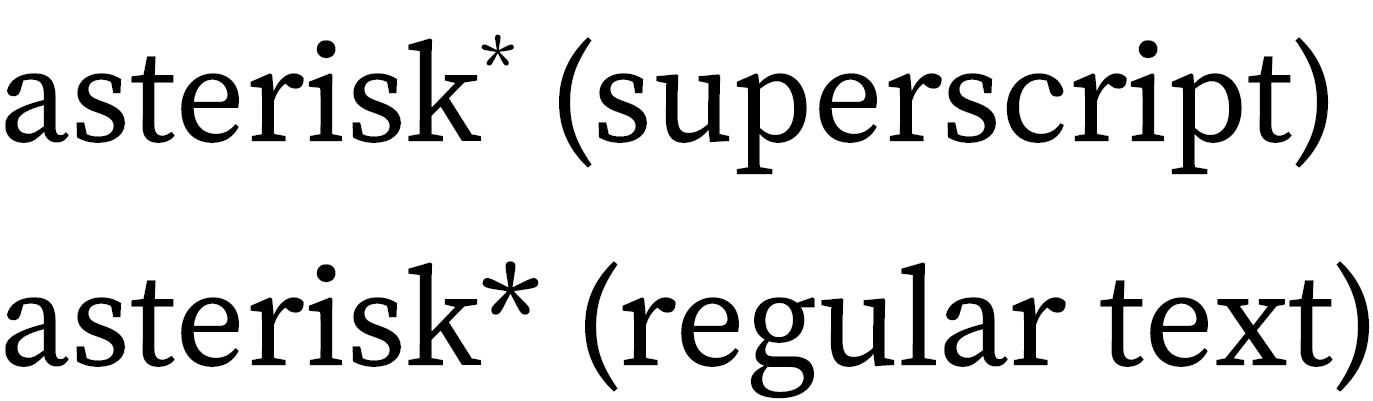
That first asterisk seems too small; the second one, formatted as regular text, looks better to us.
If your asterisks seem smaller than they should be as superscripts, try formatting them as regular text. You might consider doing the same for the daggers and double daggers, especially in the smaller font sizes that are typical in tables. (Letters and numbers, on the other hand, could be mistaken as part of the text if they’re not raised above the baseline.)
Typesetters and designers won’t always agree about what looks best for asterisks and the like, but legibility is always important. Whether you’re formatting a table (or any other text) for publication or simply editing it in Word, it’s best to make sure the note references won’t be missed.
Note: For tables, you’ll usually want to enter footnote references and their corresponding notes below the table manually instead of using the notes feature in Word or InDesign (or other program); otherwise, they’ll get mixed up with notes for the main text. See also CMOS 3.77 and 3.80.
Q. Hello! CMOS 10.8 says to italicize abbreviations only if the full term would be italicized in the text. How would you handle a term that’s defined in the text with an accompanying abbreviation in parentheses? Would both the term and the abbreviation be in italics? Thank you!
A. If the abbreviation stands for a term that’s in italics only because it’s being introduced as a word or phrase that you are defining in the text, then the abbreviation can usually be presented in regular text:
The term ibidem (ibid.) is one of the few scholarly abbreviations from Latin that remain common in academic texts.
But if the abbreviation itself is used in this way, it should be in italics:
The term ibidem (abbreviated ibid.) . . .
Quotation marks are another option:
The term ibidem (abbreviated “ibid.”) . . .
Rules related to italics for situations like these aren’t etched in granite. In general, our recommendation for key terms and their abbreviations is to use italics (and quotation marks) sparingly but without sacrificing readability. See also CMOS 7.57 (on the use of regular text for common Latin words and abbreviations), 7.58 (on italics or bold for key terms), and 7.66 (on italics or quotation marks for words used as words).
Q. Does CMOS have guidelines about using “where” to refer to something other than a place? For example, “This is a situation where extra care is needed.”
A. We don’t, but Bryan Garner, the author of chapter 5 in CMOS (on grammar and usage), does. See Garner’s Modern English Usage (5th ed., Oxford, 2022), under “where.” That entry has two relevant subentries: (1) on where for in which and (2) on where for when.
The first subentry explains that in formal prose, the locative where shouldn’t be used as a relative pronoun, as when a phrase like “a case where” is used instead of “a case in which.” But in prose with a “relaxed tone,” including text with contractions (like many of the answers in this Q&A), where is not only acceptable but may even be preferable.
Your example (“a situation where”) seems perfectly OK to us, but if you are going for a formal, elevated style, change “where” to “in which.”
As for where in place of when (which is temporal rather than locative—i.e., referring to time instead of place), Garner says that writers who do this have “misused” the word. So, for example, you should write “a year when,” not “a year where.”
Q. Why doesn’t the 18th ed. website have a downloadable PDF of the hyphenation guide, as the previous editions had? I hate scrolling.
A. The hyphenation guide under CMOS 7.96 in the eighteenth edition consists of HTML text formatted as a table, which is visible to the Find feature in browsers (unlike the PNG offered in the seventeenth edition) and is considered by accessibility experts to be preferable to PDF.
We understand that many people liked the downloadable PDF option, but the HTML table format (unlike either an image or a PDF file) can be readily converted to whatever format you’d like. Here are two options:
1. Print to PDF. In Chrome for Windows, (a) select the table text (e.g., by dragging your mouse from the top left of the table all the way down to the bottom); (b) right-click anywhere in the selected text to bring up the context menu; (c) choose Print; and (d) change Destination to Save as PDF instead of sending the table to a printer. Before you save, you can adjust the settings in Chrome to resize the table as desired or to keep the background graphics (in this case shading), among other options. Other browsers and platforms will have similar options.
2. Copy and paste into Microsoft Word. Select the table text as in step 1a above and then copy and paste it into Word. You can then use Word to adjust fonts and borders and the like as desired. This file can be used as is, or you can save it as a PDF directly from Word. These steps should work equally well in Google Docs (among other programs).
In sum, the HTML format for the table in the eighteenth edition makes it possible to create and customize your own PDF or other version of the hyphenation guide in just a few steps. The process may not be as much fun as making a miniature CMOS ornament, but the result is probably more useful.
Q. When using the author-date style, can I put two citations to one sentence like the following?
At that time, no one, including the show’s producers Matt Groening, James L. Brooks, and Sam Simon, could have anticipated the sudden “Simpsons craze” that was to come (IMDb 2026) (Henry 1994, 87).
If not, how else could I do this? Only the names of the producers were taken from IMDb while the claim of fame is from Henry 1994.
A. It’s best not to try to cite separate parts of the same sentence unless it’s perfectly clear what each citation refers to; in your example, we can’t really tell which part is from IMDb and which is from Henry.
But first, there are some other issues that should probably be addressed in your example. We’ve done some digging and determined that your “Henry 1994” almost certainly refers to the following article:
Henry, Matthew. 1994. “The Triumph of Popular Culture: Situation Comedy, Postmodernism and The Simpsons.” Studies in Popular Culture 17 (1): 85–99. http://www.jstor.org/stable/23413793.
Henry, however, does not seem to use the phrase “Simpsons craze” in that article (or the word “craze” by itself)—not on page 87 or elsewhere. Perhaps you’re drawing on this passage from page 87:
The Simpsons was, therefore, inevitable, the next logical step in the blue-collar tradition; its enormous success, however, was quite unexpected.
If that’s the case, then you shouldn’t put “Simpsons craze” in quotation marks. Some people probably referred to that show’s huge popularity in that way, but your source refers to an “enormous success,” not a craze.
Next, if it’s your own claim that the show’s producers could not have predicted the show’s success (something that Henry’s article doesn’t seem to address either), then you need to make that clear.
As for the identity of the producers, The Simpsons has had such a long run that according to IMDb (on its page for the full cast and crew), it’s had more than 150 producers to date. Moreover, the three people you list are credited at IMDb as the show’s creators, not its producers.
Taking all that into account, here’s one way that you might revise the sentence in your question (assuming you have a reason for introducing the creators at this point and that you’ve established elsewhere that you’re talking about the show’s earliest days):
According to Henry (1994), the show’s “enormous success . . . was quite unexpected.” And though Henry does not mention them, the show’s creators—James L. Brooks, Matt Groening, and Sam Simon (IMDb 2026)—were likely among those taken by surprise.
Make sure that “IMDb 2026” in your reference list includes the link to the main page for the show (https://www.imdb.com/title/tt0096697/), where the creators are listed. (But note that at IMDb’s page for the full cast and crew, only Groening gets a creator credit; Brooks and Simon are credited, along with Groening, as developers, one more thing you may want to consider when revising your text.)
Finally, if you were to cite two sources at the end of a sentence, you’d usually do that when both sources supported the same idea, in which case you’d separate them with a semicolon: (IMDb 2026; Henry 1994). See also CMOS 13.116.