Q. I’m having trouble finding guidance in CMOS about the minimum length of the final line of a paragraph (anywhere on the page). When proofreading, how do we determine whether a line is too short (or a “runt”)? I learned that it’s four characters minimum, but I can’t find CMOS confirmation of that. And then can an ellipsis be on a line on its own, and if not, should copyeditors use a nonbreaking space before a paragraph-ending ellipsis? What if there’s a closing quotation mark after it? Thanks!
A. According to CMOS 2.121 (on proofreading for overall appearance), “The last word in any paragraph must not be hyphenated unless at least four letters (in addition to any punctuation) are carried over to the final line.” You can extend this to mean that a paragraph-ending word on its own line should ideally be at least four letters long. But whatever your definition of what constitutes a “runt line,” it’s mostly a matter of taste (and applies only to print and other fixed layouts). Some publishers set a minimum of three letters; others go with as many as five. If in doubt, proofreaders should ask before starting in on the text.
As for ellipses, a paragraph-ending ellipsis on a line by itself, even if it’s followed by a quotation mark, is best avoided if you’re following a four-letter-plus-punctuation minimum (you can ignore the spaces between the dots and count the ellipsis as equivalent to a three-letter word). It’s probably best avoided anyway so it’s not mistaken for a section break.
Copyeditors, however, don’t usually decide such things. Though it’s generally a good idea to insert nonbreaking spaces within your ellipses to keep them from breaking at the end of a line as you edit (which can be annoying for you and anyone who reviews the document), you can usually leave decisions about paragraph endings to the typesetter or whoever will be preparing the document for publication.
See also CMOS 12.59–69 (on ellipses).
[This answer relies on the 18th edition of CMOS (2024) unless otherwise noted.]
Q. I’m a book editor. The designer I work with and I seem to have been trained in different decades. We differ on whether a page number in a TOC that has chapter titles that run to multiple lines should align with the top line, or (as I think) should align on the last line of the heading. I can’t find an answer in Chicago. What say you, CMOS?
A. By default, both Microsoft Word and Adobe InDesign align page numbers on the last line of an entry that runs to more than one line in their automated tables of contents. And if your TOC includes leader dots (a row of dots that connects the last word of a chapter title or other TOC entry to the corresponding page number to its right), you shouldn’t try to alter this behavior. Ditto if the page numbers simply follow the last word in each entry (after a space) instead of being placed flush right.
But even if your TOC is formatted as a conventional table and doesn’t feature leader dots, aligning the number with the last line of a chapter title that runs to more than one line syncs with our advice for aligning rows in tables where only the first column runs to more than one line (CMOS 3.71 and fig. 3.14).
So we’d tend to side with you in this case. For a real-life example that illustrates this principle of book design, follow the Google Preview link at the University of Chicago Press’s page for Tocqueville’s Democracy in America (ed. and trans. Harvey C. Mansfield and Delba Winthrop, 2000) and scroll through that book’s lengthy table of contents.
[This answer relies on the 18th edition of CMOS (2024) unless otherwise noted.]
Q. When a map is inserted sideways on a verso page, which direction should it face? Should the top of the map be near the gutter or near the outside margin? Is there a standard?
A. The practice at the University of Chicago Press is to rotate the image 90 degrees counterclockwise, which would mean that the top of the map is toward the outside margin on a verso (left-hand) page but toward the middle of the book (the gutter or binding) on a recto (right-hand) page.
A map rotated in this way is called a broadside figure (as defined in the glossary at the end of CMOS). In most books, pages are taller than they are wide, so a broadside figure will usually be in landscape (▭) rather than portrait (▯) orientation before being rotated.
[This answer relies on the 18th edition of CMOS (2024) unless otherwise noted.]
Q. We have to number our paragraphs in the research paper we are writing. What is the proper way to do this?
A. CMOS doesn’t cover this, but a convenient way to number paragraphs in MS Word or Google Docs is by using the feature for numbered lists.
In either program, you can start by selecting the paragraphs you want to number. Then use the numbering icon, which in Word is in the Paragraph group under the Home tab; in Docs, there’s a similar icon in the toolbar above the document.
You can then use the ruler in either Word or Docs to move the paragraph numbers into the left margin and to format the paragraphs with first-line indents (which may require setting a tab stop). See also CMOS 2.15.
In Word, adding a custom paragraph style will enable you to reapply this same formatting wherever it’s needed. In Docs, you’ll need a third-party add-on to do the same. But both programs include a format painter that can be used in a similar way, allowing you to copy the automatic numbering and other formatting from one paragraph and apply it to others as needed.
Word and Docs both allow you to stop and restart numbering as needed to skip over headings and the like. And if your document includes numbered lists in addition to the numbered paragraphs, you can use the options in either program to create multiple independently numbered lists.
If you need even more flexibility, and you’re comfortable digging a little deeper into the software, you can try using Word’s Seq field code to insert sequential numbers that are independent of the numbered list feature and can be placed anywhere in your document. For more details, see the article “Numbering with Sequence Fields,” by Word guru Allen Wyatt, at Tips.net.
[This answer relies on the 18th edition of CMOS (2024) unless otherwise noted.]
Q. If a document references only one figure, should it be labeled “Figure 1” or assigned no number?
A. A lone figure, even if it is referred to in the text, can usually remain unnumbered:
All but one of the posters relied on a conventional list; the outlier used an infographic (see figure).
The corresponding figure caption would begin with “Figure” or “Fig.” This approach is recommended by the AMA Manual of Style (11th ed., 4.2.7.1) and The CSE Manual (9th ed., 30.2.1.1)—though the word “figure” would be capitalized in direct references in both of those styles.
But assigning a number to such a figure would be appropriate in at least three scenarios: (1) the figure is the only one in a chapter in a book featuring numbered figures in other chapters; (2) the figure is the only one in an article in a journal whose house style requires assigning numbers for all figures for consistency across articles; and (3) the figure occurs in a context that also includes more than one numbered table (e.g., fig. 1 and tables 1 and 2).
CMOS, which is a general reference, allows for any of those approaches. But note that all figures, whether they will be numbered in the published version or not, should carry a working number in the manuscript (see CMOS 3.13).
[This answer relies on the 18th edition of CMOS (2024) unless otherwise noted.]
Q. Regarding indenting paragraphs, the online consensus seems to be that the first paragraph of text is formatted flush left, and only subsequent paragraphs are indented. Does Chicago have an opinion on this? Thanks!
A. Our opinion aligns with the consensus. In a book or other type of work that otherwise features paragraphs with first-line indents, the first paragraph in a chapter or other section normally begins flush left. This is a convention more than a rule (and not mentioned in CMOS), but most publishers today, including Chicago, tend to follow it.
Such paragraphs usually follow a chapter or other title or a section heading. The first line would also begin flush left in a paragraph that follows a section break signaled by extra line space (often in conjunction with asterisks or the like; see “Space Breaks in Fiction” at CMOS Shop Talk for an example).
Paragraph indents help readers identify new paragraphs in books and other types of works that don’t rely on extra line spacing between paragraphs to do the same thing. But after a heading or other such break, it’s obvious where the next paragraph begins, so the indent isn’t needed.
Authors can follow the convention for published works in their manuscripts, but they don’t have to. Decisions about indents and other matters of layout are usually up to a book designer or other design professional.
[This answer relies on the 18th edition of CMOS (2024) unless otherwise noted.]
Q. Where should a “praise for . . .” page be located in a novel? Thank you.
A. Praise pages, or brief excerpts from published reviews in support of a book—often a paperback edition of a book first published in hardcover—are usually printed on the opening pages, before the half-title page. Such pages are generally unnumbered, but they count in the overall Roman-numeral pagination at the beginning of the book.
[This answer relies on the 18th edition of CMOS (2024) unless otherwise noted.]
Q. What margins should I use?
A. One-inch margins all around is a typical default setting for manuscripts, whether you’re using 8.5 × 11–inch or A4 paper, except for any headers and footers, which are typically half an inch from the edge of the page. One inch is equivalent to 2.54 centimeters or 6 picas; half an inch would be 1.27 cm or 3 picas. That’s what a US English installation of MS Word shows when the measurement options under File > Options > Advanced > Display are changed from inches to centimeters or picas, respectively.
These default settings are fine to use in most cases. But if you’re writing for a publisher, consult your publisher’s guidelines (and see “How to Format a Novel for Submission” at CMOS Shop Talk). If you’re writing a dissertation or thesis or other type of paper for school, consult the latest edition of Kate L. Turabian’s Manual for Writers of Research Papers, Theses, and Dissertations (a.k.a. the Turabian manual).
[This answer relies on the 18th edition of CMOS (2024) unless otherwise noted.]
Q. Can the running heads in a multivolume set of books be the title of that particular volume rather than the overall title of all the volumes in the set?
A. Yes. Where running heads are concerned, there are few rules per se, only some useful conventions that depend on the book: “The choice of running heads . . . is governed chiefly by the structure and nature of the book” (see CMOS 1.12, which lists some common configurations). Consider the reader, and if your choice makes more sense than the alternatives, run with it.
[This answer relies on the 18th edition of CMOS (2024) unless otherwise noted.]
Q. When writing a bibliography, is it acceptable for the entry to be split between pages? Or should I insert a page break before the entry to keep it all together?
A. Please, whatever you do, do not insert a page break before the entry; if you do, then any changes you make to the document before that page break could easily result in the page just before the manual break running short. In other words, the document will no longer automatically reflow across the page break at that point. (One of a copyeditor’s many jobs is to find and eliminate such problems.)
To prevent an entry from breaking across pages, the proper way to do it is to tell your word processor to keep those lines together. First, put your cursor in the entry. Then, in Microsoft Word, go to Paragraph > Line and Page Breaks and check the box next to “Keep lines together”:
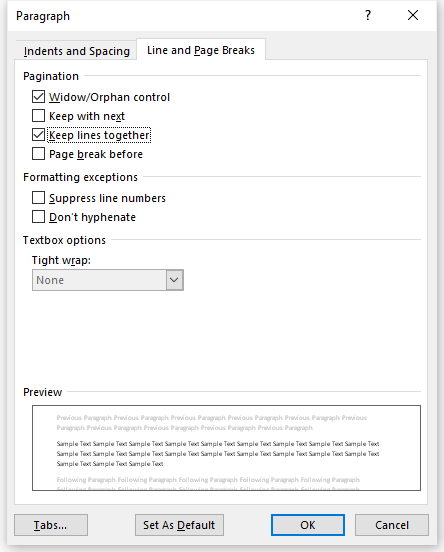
In Google Docs, the setting is under Format > Line & paragraph spacing > Keep lines together. By the way, it’s okay if a bibliography entry breaks across two pages. But note that widow/orphan control is on by default in both Word and Docs. That feature, by preventing the first or last line of a paragraph from being stranded at the bottom or top of a page, respectively, will also thereby prevent any paragraph of three lines or less—including a bibliography entry—from breaking over a page.
[This answer relies on the 18th edition of CMOS (2024) unless otherwise noted.]