Q. Dear CMOS, Would you say “in the artist’s more than fifty-year career” or “in the artist’s more-than-fifty-year career”?
A. Though it’s rarely wrong to hyphenate a compound modifier before the noun it modifies (see CMOS 7.85), we like your first version best. According to the hyphenation table at CMOS 7.89, section 2, under “adverb not ending in ly + participle or adjective,” such compounds are usually hyphenated (e.g., “a much-needed addition”), but there are exceptions.
Specifically, a compound modifier with more, most, less, least, or very (among a few other adverbs) can usually be left open (e.g., “a more thorough exam”). Accordingly, if you treat the idiomatic phrase more than as a variation of the adverb more and fifty-year as a compound adjective (see “number + noun” in section 1 of the table), you’d write “more than fifty-year career.”
[This answer relies on the 17th edition of CMOS (2017) unless otherwise noted.]
Q. Can you please add “wise” to the hyphenation table? I’m curious if you would use a hyphen in a sentence like “Accessibility-wise, my favorite city was Tokyo.”
A. Hyphenation-wise, the adverb combining form -wise would be treated like the adjective combining form -like. And according to the entry for “like” in the hyphenation table at CMOS 7.89 (section 3), compounds formed with that term are closed if they’re listed as such in Merriam-Webster; otherwise, they’re hyphenated in any position in a sentence. Likewise for -wise.
So accessibility-wise (and, as we’ve just seen, hyphenation-wise) would be written with a hyphen (because those terms aren’t in Merriam-Webster), whereas clockwise (and counterclockwise), crabwise, and (more déjà vu) likewise and otherwise—all in Merriam-Webster—would be closed.
Another term that works this way is -wide (the last entry in section 3 of the hyphenation table), as in worldwide (in the dictionary) but university-wide (not in the dictionary). We’ll consider adding -wise to a future edition of CMOS; until then, we’d advise you to proceed analogy-wise.
[This answer relies on the 17th edition of CMOS (2017) unless otherwise noted.]
Q. Our style guide states that “healthcare” must be treated as one word, but would this extend to varieties, such as mental healthcare? Merriam-Webster lists “mental health” as a separate noun, so I’m genuinely confused whether it should be “mental health care” or “mental healthcare.” Thank you!!
A. Good question! The version “mental health care,” which keeps the term “mental health” intact, makes a little more sense than “mental healthcare.” A hyphen might make that pairing even clearer—“mental-health care.” But because the term “health care” belongs together just as much as “mental health” does, the unhyphenated phrasing is still better.
In your case, however, since “healthcare” is in your style guide as one word, we’d recommend going with “mental healthcare” to jibe with your use of the word “healthcare” in other contexts. Readers are more likely to be put off by an obvious inconsistency than by a slight asymmetry.
[This answer relies on the 17th edition of CMOS (2017) unless otherwise noted.]
Q. You wouldn’t write “lineeditor,” so why “copyeditor”? Please help before my head explodes!
A. We know our preference for copyeditor isn’t popular with everyone, but judging from other copy words, it’s not all that weird. In American English, copy tends to form closed compounds, as this snippet from the 2003 first printing of Merriam-Webster’s Collegiate Dictionary (11th ed.) shows:*
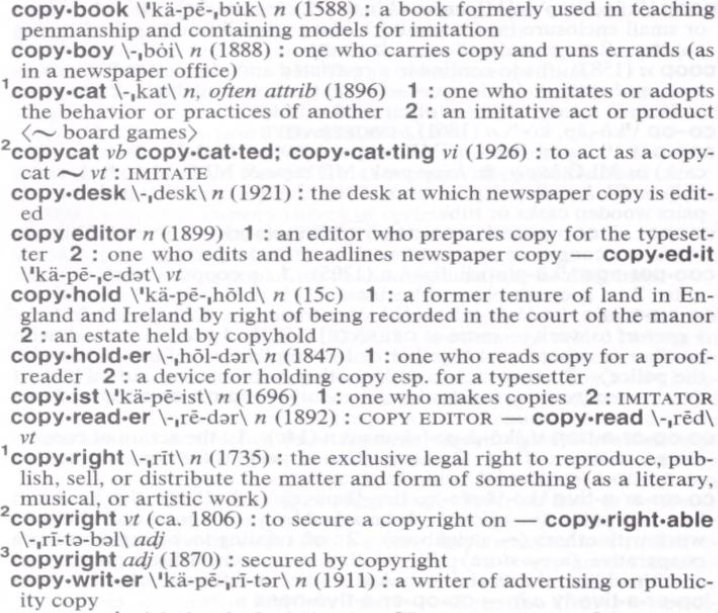
With the sole exception of copy editor, each of those terms is closed up: copybook; copyboy; copycat, copycatted, copycatting; copydesk; copyedit; copyhold; copyholder; copyreader, copyread; copyright, copyrightable; copywriter. (Copyist is also one word, but it’s not a compound.)
One of them—copyrightable—even has the same number of syllables as copy editor, stressed in the same pattern.
Merriam-Webster has since added one-word copyeditor as a less common variant for the noun and two-word copy edit as a second-listed equal variant for the verb. Our preference splits the difference, favoring consistency with other copy words over the common usage reflected in the dictionary entry.
As for line editor, those two consecutive e’s preclude a move toward one word (à la linebacker or lineman), though we’d hyphenate the -ing and -ed participles as preceding modifiers, as in “line-edited manuscripts.”
We hope our answer has reached you in time.
* Note that those dots in the dictionary entries are called division markers. Not to be confused with actual hyphens, they show where hyphens may be added to words that need to be broken at the end of a line of text.
[This answer relies on the 17th edition of CMOS (2017) unless otherwise noted.]
Q. Working on software that has an e-shop, I see a very different use of the word “checkout” vs. “check out.” Should it be “checkout now” or “check out now”?
A. A good dictionary will tell you that it’s “checkout” (one word) as a noun (often used attributively, as in “checkout line”) and “check out” (two words) as a verb. So it should be “check out now.” Or you could save yourself the editorial headaches and use “go to checkout” (or, as Amazon has it, “proceed to checkout”) rather than “check out now.”
[This answer relies on the 17th edition of CMOS (2017) unless otherwise noted.]
Q. Does CMOS prefer “best seller” and “best-selling” per the dictionary spelling (over AP style of one word, no hyphen, for both)?
A. Because best seller (two words) is the first-listed spelling in Merriam-Webster (as of August 3, 2021),* Chicago would still recommend it, along with the hyphenated best-selling. But in 2017, when the seventeenth edition of CMOS was published, those—along with best-sellerdom and best-seller list (with hyphens)—were the only options listed in that dictionary. The spelling bestseller (one word) was introduced—as a second-listed equal variant—sometime after that.
As for AP’s preference for bestselling and bestseller, those are also relatively new, dating to May 2019. Meanwhile, the OED lists bestseller and most of its derivatives, including bestsellership and bestsellerism, as one word; the verb best-sell (with a hyphen) is the sole exception.
If this looks like a trend, it is—as a comparison of each iteration of “best seller” and “best-selling” in Google’s Ngram Viewer for books published since 1900 confirms (with a clear preference for bestseller and bestselling emerging in recent decades):
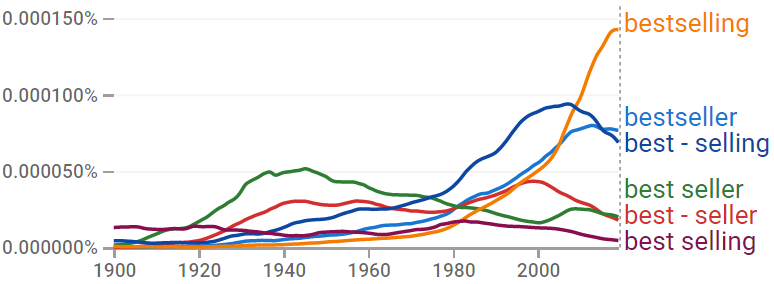
So unless you are obligated to choose the first-listed spellings in Merriam-Webster (e.g., for reasons of consistency in an ongoing project edited in Chicago style or to conform to house style), you’d be more than justified in preferring one word for bestseller and bestselling and the like. By the time the next edition of CMOS rolls around, we’d be surprised if these hadn’t become our first choices also.
[*Editor’s update: As of late 2022, Merriam-Webster has updated its entry and now lists one-word “bestseller” first, with two-word “best seller” as an equal variant.]
[This answer relies on the 17th edition of CMOS (2017) unless otherwise noted.]
Q. I work at an arts organization that has two artistic directors. Should I refer to them as “co-artistic directors” or “artistic co-directors”?
A. Co–artistic directors. Otherwise they sound like directors who are artistic. (Chicago style would make that hyphen an en dash, by the way, but that may be too much to ask of an organization with two artistic directors.)
[This answer relies on the 17th edition of CMOS (2017) unless otherwise noted.]
Q. I can’t find any consensus on this: does “quarter century” require a hyphen? Merriam-Webster doesn’t even have the term in its dictionary! (The nerve.) It seems that other online dictionaries do (and they also have a hyphen with “half-century”), but I thought it was odd that I couldn’t find “quarter century” referred to as a noun in either CMOS or M-W. Thanks!
A. Although “quarter century” doesn’t appear in CMOS, “quarter hour” turns up at 9.37 without a hyphen. When Merriam-Webster doesn’t include a phrase, you can assume that it doesn’t recognize it as a compound, and spelling it open is recommended.
[This answer relies on the 17th edition of CMOS (2017) unless otherwise noted.]
Q. I recently read an article about a con artist who was described as “running a fine wine scam.” The ambiguity—is it a fine scam with wine or a scam with fine wine?—is driving me to drink. Is it acceptable in this situation to write finewine as one word to resolve the ambiguity? Please uncork me a good answer.
A. A hyphen will create the perfect pairing: a fine-wine scam. If in actuality it was a fine scam involving plonk, rewording will produce a less flabby finish.
[This answer relies on the 17th edition of CMOS (2017) unless otherwise noted.]
Q. A colleague wants to use a hyphen in the phrase “Friday-afternoon lecture.” But isn’t this an overly rigid application of the phrasal adjective hyphenation rule in a case where it doesn’t apply? “Friday afternoon” is not a true phrasal adjective, but a temporal phrase. “Join me for Sunday morning brunch” is the same as saying, “Join me for brunch (on) Sunday morning.” Interested in your view on which is correct, and why.
A. “Noun + noun” phrases like “Friday morning,” where the first noun modifies the second noun, do qualify as phrasal adjectives. A hyphen increases readability, since Friday followed by a noun is not always part of a phrasal adjective: a Friday golf outing; a Friday birthday party. See section 2 of CMOS 7.89 (“noun + noun, single function”).
[This answer relies on the 17th edition of CMOS (2017) unless otherwise noted.]